
How to find hidden cameras in a room, one zone at a time
Updated · Tag Tracker LLC
Most people who go looking for a hidden camera wander the room, pick up a few things, and stop when nothing jumps out. A better approach is to decide what a camera would want to see, search those sightlines first, and work through every object in them in a fixed order.
This guide is about the physical search: where to stand, what to touch, and what counts as out of place. Tools come last, once you have narrowed the room down. A careful sweep of a hotel room or rental bedroom takes about 20 to 30 minutes.
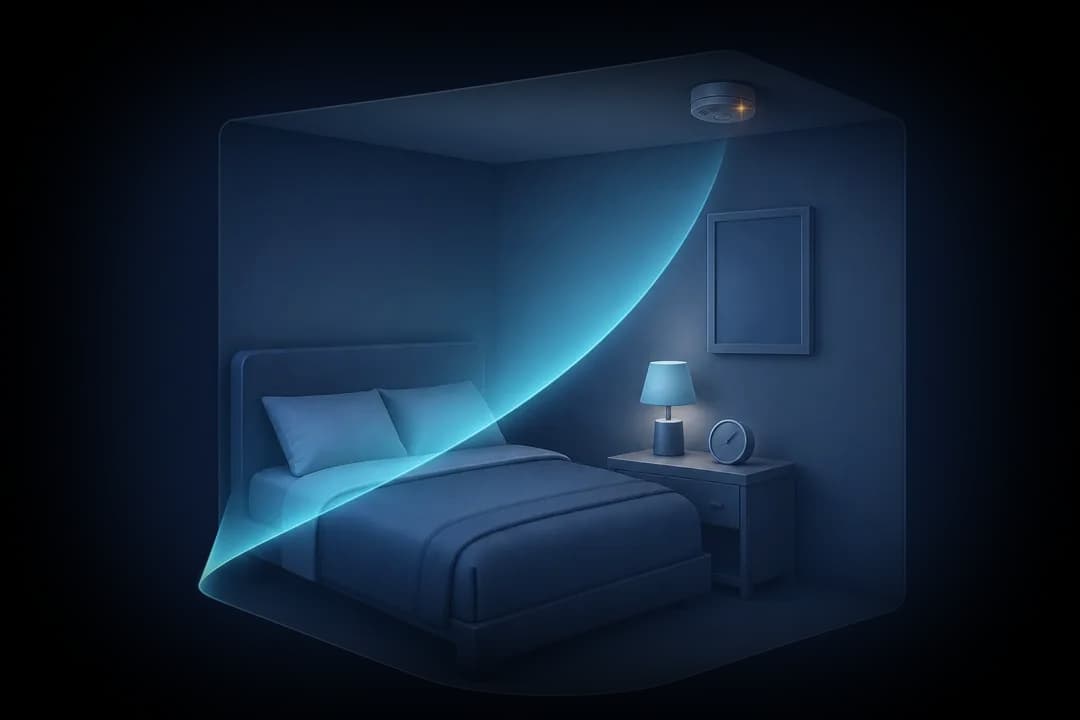
Start from what a camera wants to see
A covert camera is placed for a view, and the views people worry about are narrow: the bed, the shower, the toilet, and anywhere you undress. Stand in each of those spots and turn slowly in a full circle. Everything you can see from there could, in principle, see you. That set of objects is your priority zone.
Pay extra attention to anything at a height between roughly waist level and the ceiling that faces the spot directly. Cameras hidden low tend to see legs and furniture; cameras hidden high see the whole scene. Corners of the ceiling, the tops of wardrobes and shelves above a bed are common vantage points.
The manual pass: what to look for by hand
Before you use any tool, go through the priority zone with your hands and eyes. Lift, turn and look behind each object. You are looking for small holes, extra wires and things that do not fit the room.
- Holes that serve no purpose. A round hole of 1 to 3 mm on a clock face, a speaker grille, a picture frame edge or a tissue box, especially one with a dark glassy center.
- Power where none is needed. A cable running to a decorative object, a charger that has nothing plugged into it, or a USB adapter in an outlet facing the bed.
- Duplicates. Two smoke detectors in one small room, two chargers in one outlet, or an air freshener in a room that already smells of nothing.
- Odd angles. An object turned to face the bed or shower when its natural position would face the room or the door.
- Fresh changes. New screws, patched plaster, a ceiling tile slightly out of line, or tape on the back of a mirror.
- Weight and warmth. An object that feels heavier than it should, or is slightly warm to the touch, may have a battery or circuit inside.
Common hiding objects to handle first
Some items come up again and again because they are ordinary, often powered, and naturally face into a room. Check these before anything else in the priority zone: smoke detectors, alarm clocks, phone chargers and USB adapters, wall outlets and power strips, picture frames and mirrors, air purifiers and fresheners, lamps, TVs and set-top boxes, smart speakers, and stuffed toys or plants on shelves. In bathrooms, add vents, towel hooks and anything on the counter that faces the shower or toilet.
Do not forget the ceiling. Light fittings, ceiling fans, sprinklers and motion sensors sit above eye level and are easy to skip.
Then bring in the tools
After the manual pass, darken the room. A flashlight held next to your eye will make a lens flash back as a small, sharp point. Your phone can do more: on Android, Candor runs a lens finder that marks those reflections, an infrared check that can show night-vision LEDs, a Wi-Fi camera scan of the network you have joined, a Bluetooth scan, and a magnetic sensor for finding electronics inside objects that should be empty. Each tool reads a different trace, which is why the detection methods guide sorts them by the signal they pick up.
Use the tools to confirm or rule out what the manual pass turned up, and to cover places your hands could not reach.
If something looks wrong
Do not break objects open or pull devices off walls. Cover the suspect object with a towel or tape if that is safe, or unplug it if it runs from a normal outlet, and photograph it in place. Report it to the host, hotel, platform or building management. Recording people in private spaces is illegal in many places, so if you believe it happened, contact local police as well.
Sweep a bedroom and bathroom for hidden cameras
- Map the sightlinesStand at the bed, the shower, the toilet and where you will change. From each spot, note every object that faces you.
- Handle each object in the zonePick up, turn over and look behind everything you noted. Check for pinholes, extra cables, fresh screws and anything aimed oddly.
- Follow the powerTrace cables from every outlet and power strip to the device they feed. Question any adapter or charger with nothing attached to it.
- Look upCheck ceiling fittings, detectors, vents and the tops of tall furniture, using a chair only if it is stable.
- Darken the room and look for glintsClose curtains, turn off lights and sweep a flashlight slowly across the priority zone, or use Candor's lens finder and infrared check.
- Scan the network and nearby devicesJoin the Wi-Fi and run a camera scan, then run a Bluetooth scan in each zone and walk toward any unexplained device.
- Record and reportPhotograph anything suspicious in place, cover it if safe, and report it rather than taking it apart.
What a phone check cannot find
- A lens set deep inside an object, behind tinted plastic, or aimed away from where you stand may not give back a visible glint.
- A camera that records to a memory card and never joins a network will not appear in a Wi-Fi or Bluetooth scan; only the physical search can find it.
- Spaces you cannot reach safely, such as above a fixed ceiling or inside a wall, are beyond a guest's search.
Frequently asked questions
Where are hidden cameras most often found?
In ordinary objects that face a bed or bathroom area and have a reason to be powered: detectors, clocks, chargers, outlets, frames, lamps and TVs. Placement is driven by the view the camera wants.
How long does a proper sweep take?
About 20 to 30 minutes for a bedroom and bathroom if you work in order. A quick flashlight pass alone takes a few minutes but misses anything off your line of sight.
Should I check the living room too?
Yes, but after the private areas. Some rental platforms allow disclosed cameras in certain areas, and a device near the front door may be a doorbell. The rules differ by platform and country.
Can I find hidden cameras without any equipment?
Often, yes. The manual pass and a flashlight find many cheap cameras because they rely on a visible pinhole and a power source. Tools add network and electronic checks your eyes cannot make.