
How to find a camera lens by the light it sends back
Updated · Tag Tracker LLC
Every camera, however small, has to look at its subject through a lens. That requirement is its weak point. A lens with a sensor behind it sends light back toward wherever it came from, and with the right technique you can see that return as a tiny, hard point of light from several meters away.
This is what a hidden camera finder does, whether it is a dedicated red-LED viewer, a phone app or a plain flashlight. The tool matters less than the method. This guide covers the physics in one paragraph, then the conditions, the grid pattern, and how to separate a real lens from the many things that also shine.
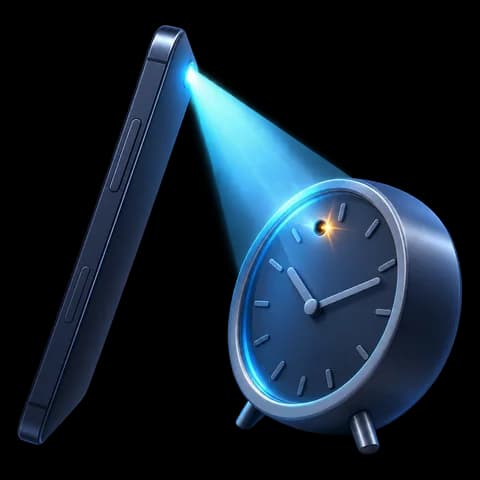
Why a lens shines back at you
A small camera lens focuses incoming light onto a flat sensor. Some of that light bounces off the sensor and the lens surfaces and travels back out through the lens along nearly the same path it came in. The effect is called retroreflection, the same principle that makes road signs and animal eyes glow in headlights. The practical consequence is simple: you only see the return if your eye is very close to the light source. Hold the light beside your eye, not at arm's length.
Setting up the conditions
- Make the room as dark as you can. Close curtains and turn off every light. The reflection is faint; ambient light washes it out.
- Keep the light at eye level. Rest a flashlight against your cheekbone, or look at your phone screen with the flashlight next to the rear camera, which puts the camera and light almost on the same axis.
- Work at one to three meters. Too close and the beam is too wide to aim well; too far and a 1 mm pinhole returns too little light. Move closer to anything that catches your attention.
- Use a narrow beam if you have one. A focused beam makes the return stand out more against the room.
- Go slow. A lens only returns light when it faces you. Pan at a pace where you can watch every surface pass through the beam.
The red filter trick
Dedicated lens-finder viewers use red LEDs and a red-tinted window for a reason. Viewed through red glass, most of the room turns a dull, even red, while a lens returning red light shows as a small bright point with more contrast. You can copy the idea with a red flashlight and a piece of red transparent plastic, or by holding red plastic over your eye while you sweep a white light. It is not required, but it helps some people pick out small points faster.
Lens glint or something else?
Plenty of things reflect a flashlight. Learning the differences saves you from panic and from missing the real thing.
- A lens gives a small, round, sharp point that stays steady and in the same place as you shift your head a few centimeters. It often has a slight blue, purple or red tint.
- Flat glass and mirrors give a broad sheet of light that slides across the surface as you move.
- Screw heads and metal trim give a spread or streaky highlight, often with a cross or line shape, and it changes shape as the angle changes.
- Glossy plastic reflects in a smear or band rather than a point.
- Status LEDs glow even when your light is off. Switch your light off: if the point stays, it is emitting its own light, not reflecting yours.
- Water drops and crystals can give sharp points, but they usually cluster and move with the angle.
Using a phone as the finder
A phone makes a good finder because its flashlight sits right beside the rear camera. On Android, Candor's lens finder turns on the flashlight and marks small, sharp, bright reflections in the live view, so you have a second pair of eyes on the screen. It still needs line of sight, and it will mark screws, LEDs and glossy plastic too; you decide what each mark is. A front-camera infrared mode can also reveal night-vision LEDs, which is covered in the infrared guide.
If you find a genuine lens aimed at a bed or bathroom area, cover it if you safely can, photograph it in place, and report it to the host, hotel or platform. Do not take it apart.
Search a wall for lenses in a grid
- Darken and positionTurn off the lights, close the curtains and stand two to three meters from the first wall, facing it squarely.
- Divide the wall into bandsTreat the wall as three horizontal bands: floor to waist, waist to head height, and head height to the ceiling.
- Sweep each band slowlyWith the light beside your eye, pan left to right across one band, then back across the next. Watch for a steady, sharp point of light.
- Change your standing pointMove a meter to the side and repeat. A lens angled away from you on the first pass may face you on the second.
- Confirm each candidate up closeWalk to anything that shone, switch your light off to rule out an LED, then look with the light at a few angles to rule out glass or metal.
- Repeat for every wall and the ceilingWork around the room, then sweep the ceiling from below, paying most attention to surfaces that face the bed, shower and toilet.
What a phone check cannot find
- A lens can only return light to you if it faces where you stand, so a camera pointing at the bed from a high corner may show nothing from the doorway.
- Pinholes behind tinted plastic, one-way glass or a fabric covering may not reflect enough light to see.
- Reflection tells you a lens may be present; it does not say whether the camera is on, recording or connected.
Frequently asked questions
What color is a hidden camera lens reflection?
Often a small bluish, purplish or reddish point, depending on lens coatings and your light. With a red-LED viewer it appears as a bright red dot. Shape and steadiness matter more than color.
Does the lens have to be turned on to reflect?
No. Reflection comes from the glass and sensor, so a switched-off camera reflects just as well. This is why lens finding catches offline cameras that network scans cannot see.
How far away can I spot a lens?
Pinhole lenses are easiest to spot within about three meters in a dark room. Larger lenses can show from farther away. Move closer to confirm anything you think you saw.
Is a dedicated lens finder better than a phone flashlight?
The red filter gives some people better contrast, but the principle is the same. A careful phone sweep in a dark room finds most of what a viewer finds.